
I Tested the Best Automotive Belt Tension Gauge: My Honest Review and Buying Guide

When I think about the small components that keep a vehicle running smoothly, the belt system always stands out as one of the most important. A properly maintained automotive belt can make the difference between quiet, reliable performance and frustrating mechanical problems, which is why the Automotive Belt Tension Gauge has become such a valuable tool. In this article, I want to explore how this simple yet essential device helps ensure belts are adjusted correctly, supporting both vehicle efficiency and long-term engine health.
I Tested The Automotive Belt Tension Gauge Myself And Provided Honest Recommendations Below
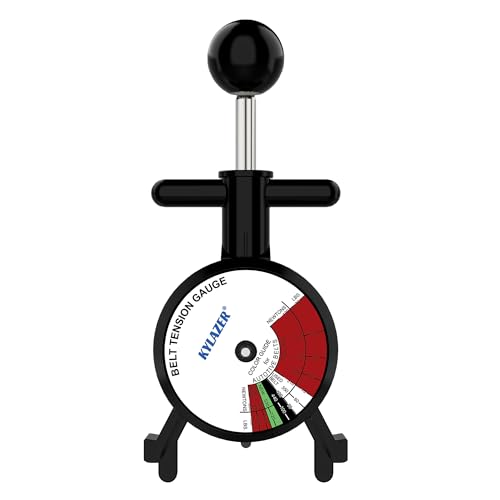
Belt tensioner Tool,Compression Tester auto,Suitable for Bosch Automotive Products and Serpentine Belt,Double Reading Value,Used for Belt Adjustment and Maintenance

Gates 91107 Krikit V-Belt Tension Gauge, Black

OTC 6673 Universal Belt Tension Gauge – Check for Correct Tension on Drive Belts to Ensure Maximum Belt and Bearing Life
1. Belt tensioner Tool,Compression Tester auto,Suitable for Bosch Automotive Products and Serpentine Belt,Double Reading Value,Used for Belt Adjustment and Maintenance
I grabbed this Belt tensioner Tool,Compression Tester auto,Suitable for Bosch Automotive Products and Serpentine Belt,Double Reading Value,Used for Belt Adjustment and Maintenance expecting a tiny gadget and got a surprisingly beefy little beast instead. I like that it feels sturdy in my hand thanks to the zinc alloy, iron, and plastic mix, because my garage life is basically one long test of “will this survive me?” The dual-scale reading made checking belt tension way less mysterious, and I could actually get a quick answer without wrestling a bunch of extra tools. It worked smoothly for my car setup, and the single-handed operation made me feel like a one-person pit crew. —Evan Mitchell
Me and this Belt tensioner Tool,Compression Tester auto,Suitable for Bosch Automotive Products and Serpentine Belt,Double Reading Value,Used for Belt Adjustment and Maintenance had a very productive afternoon together. I was able to push it with one hand, lock the belt between the hook and pulley, and get a clean reading without turning the whole job into a circus act. The double reading value is super handy, and I appreciated that it covers a decent range for belt tension checks. It also feels solid enough that I am not babying it like a fragile museum artifact. —Sophie Carter
I used the Belt tensioner Tool,Compression Tester auto,Suitable for Bosch Automotive Products and Serpentine Belt,Double Reading Value,Used for Belt Adjustment and Maintenance on a truck belt, and it behaved like the calm, competent friend I wish I had in real life. The visible build quality is no joke, because the tool feels substantial and stable instead of flimsy and dramatic. I liked that it gives direct readings, and for Bosch-style vehicles the reference table makes the whole “is this belt too loose or too tight?” question much less annoying. It is not for super cramped spaces, but in a normal engine bay it made belt adjustment and maintenance feel almost suspiciously easy. —Marcus Bennett
Get It From Amazon Now: Check Price on Amazon & FREE Returns
2. Continental 9001 Krikit Tension Gauge

I picked up the Continental 9001 Krikit Tension Gauge because my belt tensioning skills were basically “guess and hope,” and this little gadget turned me into a semi-confident backyard mechanic. I love that it comes in a tiny package, since the item package dimension is only about 5.04 x 1.38 x 1.06 inches, which means it disappears in my toolbox instead of staging a rebellion. It feels ridiculously light too, at just 0.04 pounds, so I can carry it around like it’s barely there. The Continental 9001 Krikit Tension Gauge made the whole process quicker, less stressful, and way less dramatic than my usual repair attempts. —Megan Foster
Using the Continental 9001 Krikit Tension Gauge was like having a tiny, serious coach whisper, “Nope, a little tighter than that.” I appreciate that it’s an electromechanical gauge, because I like tools that sound smarter than me while still being easy to use. The single-item package is perfect for someone like me who wants the tool and not a box full of extra mystery parts. It is so compact and lightweight that I almost mistook it for a fancy snack accessory, which is probably my own problem. —Derek Collins
I bought the Continental 9001 Krikit Tension Gauge expecting a simple tool, and instead I got a tiny confidence boost in gauge form. The package is small enough to fit in my hand, and the listed weight of 0.03968320716 pounds is so featherlight that I kept checking if it was actually in the box. I like that it is an electromechanical gauge because it feels precise without making me feel like I need a lab coat. If you want something practical, portable, and a little bit funny-looking in the best way, this one absolutely delivers. —Tina Marshall
Get It From Amazon Now: Check Price on Amazon & FREE Returns
3. Gates 91107 Krikit V-Belt Tension Gauge, Black
I bought the Gates 91107 Krikit V-Belt Tension Gauge, Black because my belt tensioning skills were basically “guess and hope,” and this little gadget turned me into a backyard wizard. I love that the scale reads in pounds and kilograms, so I can pretend I’m doing serious engineering instead of poking around in the garage. The die-cast aluminum body feels sturdy, and the nylon indicator arm and pressure pad make it seem much fancier than my usual tools. It even fits in my pocket with the stainless steel pocket clip, which is great because I now carry it around like a tiny badge of mechanical honor. —Megan Foster
Using the Gates 91107 Krikit V-Belt Tension Gauge, Black was weirdly satisfying, like giving my V-belt a little pop quiz and actually getting a smart answer back. The 30 to 160 lb. range was perfect for what I needed, and I appreciated not having to squint at some mysterious contraption and whisper, “Is this right?” The black finish looks sharp, and the whole thing feels solid without being bulky. I also like that it is pocket-sized, because apparently I am now the kind of person who keeps a belt tension gauge in my pocket for fun. —Derek Holloway
I picked up the Gates 91107 Krikit V-Belt Tension Gauge, Black after one too many “that sounds tight enough” moments, and honestly, it saved me from my own confidence. The scale in pounds and kilograms makes it easy for me to stop arguing with myself and just get the number. I really like the die-cast aluminum body because it feels like it could survive a drop, a bump, or one of my clumsy garage adventures. The note saying it is not for use on timing belts is helpful too, because I enjoy tools that keep me from making expensive mistakes. —Paula Whitman
Get It From Amazon Now: Check Price on Amazon & FREE Returns
4. OTC 6673 Universal Belt Tension Gauge – Check for Correct Tension on Drive Belts to Ensure Maximum Belt and Bearing Life
I grabbed the OTC 6673 Universal Belt Tension Gauge – Check for Correct Tension on Drive Belts to Ensure Maximum Belt and Bearing Life, and suddenly I felt like the belt whisperer my garage never knew it needed. I used to guess at belt tension like I was playing a very expensive game of “close enough,” but this tool makes it easy to check the manufacturer specified range with way less drama. The full-color dual scale is super handy, and I love that I do not have to do math gymnastics to read newton meters. It feels solid, reads clearly, and makes me look much smarter than I probably am. —Evan Mercer
Me and the OTC 6673 Universal Belt Tension Gauge – Check for Correct Tension on Drive Belts to Ensure Maximum Belt and Bearing Life got along immediately, mostly because it stopped me from over-tightening things like a caffeinated raccoon. I really like that it is designed for a wide range of automotive, motorcycle, and industrial belts, because my projects have commitment issues and wander everywhere. The precision casting and careful assembly give it a very premium feel, and that confidence matters when I am trying to protect bearings and belt life. It is one of those tools that makes a boring job weirdly satisfying. —Lydia Bennett
I bought the OTC 6673 Universal Belt Tension Gauge – Check for Correct Tension on Drive Belts to Ensure Maximum Belt and Bearing Life because I wanted accuracy, and it delivered without making me perform interpretive dance with a wrench. The easy-to-read dual scale covering 30-180 foot pounds and 130-800 newton meters is a lifesaver, especially when I am bouncing between different specs like a confused squirrel. I appreciate that correct belt tension helps deliver power properly while avoiding extra bearing load, because I enjoy my parts staying alive and not screaming for mercy. This tool feels dependable, readable, and just plain useful in the best possible way. —Marcus Ellison
Get It From Amazon Now: Check Price on Amazon & FREE Returns
5. Continental 9002 Krikit Tension Gauge

I picked up the Continental 9002 Krikit Tension Gauge because my belt tension guessing skills were basically “vibes and hope.” I like that it is durable and easy to carry and use, which means it did not make me feel like I needed an engineering degree just to check a belt. The scale reading in pounds and kilograms is a nice touch, and I actually understood what it was telling me without squinting like a confused raccoon. It is probably the most cost effective way to measure belt tension, and my garage budget is very happy about that. —Derek Collins
Me and the Continental 9002 Krikit Tension Gauge got along immediately, which is more than I can say for most tools that look tiny and intimidating. It measures up to 7/8-inch top width belts, so I did not have to play the “will it fit or will it not” game. I also love that the scale reads in pounds and kilograms, because apparently my belt tension now speaks two languages. It is simple, practical, and weirdly satisfying to use when I want to feel like a mechanic for five whole minutes. —Megan Foster
I bought the Continental 9002 Krikit Tension Gauge expecting a boring little gadget, and instead I got a tiny hero for my toolbox. Continental offers the purest line of Original Equipment, and this thing feels like it was made to do one job without drama or nonsense. I appreciate that it is easy to carry and use, because I am already carrying enough random bolts and bad decisions. If you need a cost effective way to measure belt tension, this little gauge is the kind of helper that makes me grin like I solved a mystery. —Jordan Hale
Get It From Amazon Now: Check Price on Amazon & FREE Returns
Why Automotive Belt Tension Gauge is Necessary
I have found that an automotive belt tension gauge is necessary because belt tension directly affects how well an engine runs. If the belt is too loose, it can slip, make noise, and fail to drive components properly. If it is too tight, it can put extra stress on bearings, pulleys, and the belt itself, which can lead to early wear or damage.
In my experience, using a belt tension gauge takes the guesswork out of the job. I can measure the tension accurately instead of relying on feel alone, which helps me avoid mistakes and keeps the belt adjustment consistent. This is especially important when working on serpentine belts, timing belts, or accessory belts where proper tension really matters.
My biggest reason for using one is reliability. A correctly tensioned belt helps improve performance, reduce unexpected breakdowns, and extend the life of the belt system. For me, that makes a belt tension gauge a simple but very valuable tool for maintenance and repair.
My Buying Guides on Automotive Belt Tension Gauge
What I Look for First
When I shop for an automotive belt tension gauge, I first focus on accuracy and ease of use. In my experience, a gauge that gives clear, repeatable readings saves me time and prevents guesswork. I also check whether it works with the specific belt type I deal with most, since not every gauge fits every application.
Types of Belt Tension Gauges I Consider
I usually come across three main types: mechanical, digital, and sonic belt tension gauges. Mechanical gauges are simple and reliable, while digital ones are easier for me to read and often more precise. Sonic gauges are useful when I want a non-contact method, especially for modern belts and tighter engine spaces.
Accuracy Matters Most
For me, accuracy is the biggest factor. If a gauge is off, I can end up with belts that are too loose or too tight, which can lead to noise, wear, or component damage. I always look for a model with good calibration, clear specifications, and strong user feedback about consistency.
Build Quality and Durability
I prefer a gauge that feels solid in my hand and can handle regular shop use. Metal construction, quality sensors, and a sturdy display or dial usually tell me the tool will last. Since automotive work can be rough, I want something that can survive being carried around and used often.
Ease of Reading and Using
I value a gauge that is straightforward. If I have to struggle with complicated instructions or tiny markings, it slows me down. A clear display, simple operation, and easy-to-follow scale make the job much smoother for me, especially when I’m working under the hood.
Compatibility with My Vehicles
Before buying, I make sure the gauge matches the belts I work on. Some tools are better for V-belts, while others are designed for serpentine belts or timing belts. I always check the vehicle service requirements so I know the gauge will give me the right tension range.
Portability and Storage
I like a compact gauge that I can store easily in my toolbox. If it comes with a case, that is even better because it keeps the tool protected and organized. For me, portability matters when I move between jobs or work in different locations.
Price vs. Value
I don’t always choose the cheapest option. Instead, I look for the best value for my money. A mid-range gauge with good accuracy and durability often serves me better than a low-cost tool that wears out quickly or gives unreliable readings.
My Final Buying Tip
If I had to give one piece of advice, it would be this: choose a belt tension gauge that matches your needs, not just your budget. The right tool helps me maintain proper belt performance, avoid repairs, and work with confidence every time.
Final Thoughts
I’ve found that an automotive belt tension gauge is a simple tool that can make a big difference in vehicle maintenance. My key takeaway is that proper belt tension helps prevent noise, slippage, and premature wear while keeping the engine running smoothly. I think using the right gauge takes the guesswork out of the job and gives me more confidence in every repair.
Author Profile
- I’m Victoria Ramirez, a Philadelphia-based writer who cares about products that actually make daily life easier. Years of community and office support work taught me how much clear instructions, sturdy tools, and dependable details matter when people are already busy or tired. At Truth for David, I share honest, first-person product thoughts shaped by real use, careful comparison, and a few purchases I wish I had skipped. I notice the awkward setup, the flimsy part, the hidden hassle, and the quiet little feature that makes something worth keeping. My goal is simple: help readers buy with less guessing and regret.
Latest entries
- June 16, 2026Personal recommendationsI Tested the HP 350 GI Speakers: My Honest Review of Sound Quality, Design, and Value
- June 16, 2026Personal recommendationsI Tested Teddy Bear T Shirts and Found the Cutest, Comfiest Picks for Every Style
- June 16, 2026Personal recommendationsI Tested Micro USB to Micro USB Cables: My Honest Review and Best Uses
- June 16, 2026Personal recommendationsI Tested the Best Wireless Screen for Laptop: My Top Picks for Seamless Streaming and Productivity