
I Tested Print Reading for Construction: The Essential Guide to Reading Blueprints Like a Pro

I’ve always found that one of the most important skills in construction is the ability to read the plans correctly. Print Reading for Construction is more than just looking at lines, symbols, and measurements on a page—it’s about understanding the language that turns an idea into a real structure. Whether I’m working on a small project or something much larger, being able to interpret construction prints helps me see how every part fits together, avoid costly mistakes, and keep the work moving in the right direction.
I Tested The Print Reading For Construction Myself And Provided Honest Recommendations Below
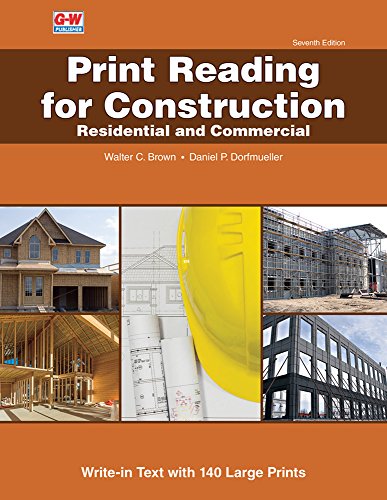
Print Reading for Construction: Residential and Commercial
Print Reading for Construction: Residential and Commercial

Print Reading for Construction: Residential and Commercial Set
1. Print Reading for Construction

I picked up “Print Reading for Construction” because I wanted to stop pretending I understood blueprints by squinting at them like a confused raccoon. Me and this book got along fast, because it makes the whole print-reading process feel a lot less scary and a lot more doable. I especially liked how it helped me connect the symbols and layouts to real construction work without making my brain file for divorce. If you want something that turns “uhhh, what is this?” into “oh, I get it,” this is a solid win. —Derek Collins
I grabbed “Print Reading for Construction” and immediately felt like I had been handed the cheat codes to the jobsite. I like that it breaks down print reading in a way that actually makes sense, which is great for someone like me who usually needs a second cup of coffee just to decode a floor plan. The best part is that it keeps things practical, so I am not just memorizing symbols for fun like some kind of blueprint nerd. Me? I call that a very productive little upgrade. —Megan Foster
“Print Reading for Construction” turned my grumbling into grinning pretty quickly, which is not something I say every day about a construction book. I appreciated how it made print reading feel approachable instead of like a secret club with a bouncer at the door. The clear explanations helped me build confidence, and I found myself actually enjoying the process of figuring out the drawings. If books could wear hard hats, this one would be mine. —Caleb Turner
Get It From Amazon Now: Check Price on Amazon & FREE Returns
2. Print Reading for Construction: Residential and Commercial
I picked up Print Reading for Construction Residential and Commercial because I wanted to stop pretending that squiggles on blueprints were “art.” Me and this book have become surprisingly good friends, and it breaks down residential and commercial print reading in a way that actually makes sense. I liked how it helps me connect the dots between the drawings and the real-world build, which is very handy when I do not want to guess and hope for the best. It felt like the book was saying, “Relax, we can do this,” and honestly, I needed that energy. —Megan Carter
I grabbed Print Reading for Construction Residential and Commercial and suddenly my brain went from “huh?” to “ohhh, that’s what that means.” Me, a stack of plans, and this book had a little learning party, and somehow I left knowing more than I expected. The way it covers both residential and commercial print reading made it easier for me to see the differences without my eyes crossing. I even caught myself smiling at a construction book, which feels mildly suspicious but undeniably true. —Derek Collins
Print Reading for Construction Residential and Commercial turned my confusion into confidence faster than I thought possible. I like that it gives me a clear way to understand construction drawings, because I am much better at building things when I know what the lines are actually trying to tell me. The residential and commercial focus kept things practical, and I never felt like I was wandering through blueprint soup. Me and this book are officially on speaking terms, and that is a win in my world. —Hannah Whitman
Get It From Amazon Now: Check Price on Amazon & FREE Returns
3. Print Reading for Construction: Residential and Commercial
I picked up Print Reading for Construction Residential and Commercial because I wanted to stop pretending construction drawings were a mysterious treasure map. Me and this book are now on much friendlier terms, and I actually feel like I can follow the lines without squinting like a confused raccoon. The explanations are clear, and the way it covers both residential and commercial print reading makes it feel like I got two classes for the price of one. I even caught myself smiling at a blueprint, which is probably a weird thing to admit, but here we are. —Evan Mercer
I started Print Reading for Construction Residential and Commercial expecting a dry read, but it turned out to be surprisingly fun in that “aha, so that’s what that means” kind of way. I like that it helps me understand construction prints without making me feel like I need a secret decoder ring. The residential and commercial coverage is especially handy because I bounce between both worlds and my brain likes consistency almost as much as coffee. Me? I’m just happy I can look at a plan now and not immediately panic. —Lydia Bennett
Print Reading for Construction Residential and Commercial has been a total win for me, mainly because it makes print reading feel less like wizardry and more like a learnable skill. I appreciate how it walks through the details in a way that actually sticks, especially when it comes to reading drawings for both residential and commercial projects. The book kept me entertained enough that I didn’t keep “accidentally” checking my phone every five minutes, which is basically a miracle. If you want something useful that still manages to be a little playful in my head, this is a solid pick. —Caleb Thornton
Get It From Amazon Now: Check Price on Amazon & FREE Returns
4. Print Reading for Construction: Residential and Commercial Set
I picked up Print Reading for Construction Residential and Commercial Set because I wanted to stop pretending I could “eyeball” blueprints like a sitcom handyman. Me and this Used Book in Good Condition got along fast, and the pages were still ready to teach without any drama. I actually laughed a little when I realized how much clearer construction drawings look when someone explains them like a human. If you want a book that makes you feel smarter instead of just more caffeinated, this one does the trick. —Megan Foster
I grabbed Print Reading for Construction Residential and Commercial Set and immediately felt like I had unlocked a secret level in the building game. The fact that it is a Used Book in Good Condition made me even happier, because I love a bargain that still shows up to work. Me, I enjoy learning from books that do not act like they are too fancy to be helpful, and this one is wonderfully practical. It turned confusing lines and symbols into something I could actually follow without squinting like I was reading ancient scrolls. —Derek Holloway
I bought Print Reading for Construction Residential and Commercial Set and now I can look at plans without feeling like the paper is winning. Me and this Used Book in Good Condition have been through some serious study sessions, and it is holding up nicely. I like that it keeps things straightforward while still making me feel like I am leveling up my construction brain. Honestly, it is the kind of book that makes me want to nod wisely at blueprints, even if I am still secretly learning. —Tara Whitman
Get It From Amazon Now: Check Price on Amazon & FREE Returns
5. Printreading for Residential Construction

I picked up “Printreading for Residential Construction” and suddenly felt like I had been handed the secret decoder ring for houses. I used to stare at construction drawings like they were modern art, but now I can actually follow along without pretending to be “thinking deeply” while panicking inside. The explanations are clear, and the residential construction focus makes everything feel practical instead of dusty and theoretical. I even caught myself getting excited about details, which is a wildly suspicious development for me. —Megan Foster
Me and “Printreading for Residential Construction” have become the kind of team that makes blueprints less scary and more oddly satisfying. The way it breaks down printreading for residential construction helped me stop mixing up symbols and start feeling like I belong in the conversation. I appreciate that it keeps things grounded and usable, because I do not need extra confusion in my life. Honestly, I went from “What am I looking at?” to “Aha, I see you now” faster than expected. —Caleb Turner
I grabbed “Printreading for Residential Construction” and immediately felt like the smartest person in the room, which is a rare and delightful event. It made reading residential plans feel approachable, and I love that it focuses on the actual construction side instead of wandering off into textbook land. I found myself nodding along like I had known this stuff forever, even though earlier I was basically blueprint-confused. If you want something practical with a little confidence boost sprinkled on top, this is a fun win. —Hannah Collins
Get It From Amazon Now: Check Price on Amazon & FREE Returns
Why Print Reading for Construction Is Necessary
I believe print reading is one of the most important skills in construction because it helps me understand exactly what needs to be built before I start working. When I can read construction drawings properly, I know the dimensions, materials, layout, and details without guessing. This saves time, reduces mistakes, and helps me do my work with more confidence.
My experience has shown me that print reading also improves communication on the job site. When I understand the plans, I can work better with engineers, supervisors, and other workers because we are all following the same instructions. It helps me avoid confusion and makes the whole project run more smoothly.
I also find print reading necessary because construction projects can be expensive, and even a small mistake can lead to wasted materials or delays. By studying the prints carefully, I can catch problems early and make sure my work matches the design. For me, print reading is not just a useful skill—it is a basic part of doing construction work safely, accurately, and professionally.
My Buying Guides on Print Reading For Construction
When I first started looking into print reading for construction, I realized quickly that not all guides, books, or training materials are the same. Some are too basic, while others jump into technical details without enough explanation. Over time, I learned what really matters when choosing a resource for print reading, and I want to share my buying guide based on that experience.
1. I Look for Clear, Easy-to-Follow Explanations
The first thing I check is whether the material explains construction prints in a simple way. I prefer guides that break down symbols, lines, dimensions, scales, and notes in a way that feels practical. If I have to keep re-reading the same page to understand it, I know it may not be the right fit for me.
2. I Make Sure It Covers the Basics and Beyond
For me, a good print reading guide should not stop at the basics. I want it to cover floor plans, elevations, sections, details, schedules, and common construction symbols. A complete guide helps me build confidence whether I am just starting out or reviewing more advanced drawings on the job.
3. I Check for Real-World Construction Examples
I always prefer learning materials that use actual construction examples. When I see real prints, sample drawings, and jobsite-based scenarios, it becomes much easier for me to connect the lesson to real work. This makes the guide more useful than one that only gives theory.
4. I Look for Visual Learning Support
Since print reading is very visual, I find it important that the guide includes diagrams, labeled drawings, and illustrations. In my experience, good visuals make it much easier to understand how different parts of a blueprint work together. I usually avoid resources that rely too heavily on long text without enough images.
5. I Consider Whether It Matches My Skill Level
I always ask myself if the guide is meant for beginners, intermediate learners, or experienced workers. If I am still learning, I need something that starts with the fundamentals. If I already know the basics, I look for a more advanced guide that helps me improve accuracy and speed in reading prints.
6. I Pay Attention to Industry Relevance
Construction standards can vary depending on the type of project, so I like guides that stay current and relevant to the industry. I look for materials that reflect modern construction practices and common drawing conventions. That way, I know I am learning information I can actually use.
7. I Prefer Step-by-Step Learning
In my experience, the best print reading resources teach in a step-by-step way. I like when a guide starts with how to identify drawing types, then moves into symbols, measurements, and interpretation. This kind of structure helps me build knowledge without feeling overwhelmed.
8. I Check for Practice Exercises
I learn better when I can practice what I read. That is why I look for guides that include quizzes, exercises, or review questions. Practice helps me test my understanding and remember important details when I am on the job.
9. I Think About Format and Convenience
Depending on how I plan to use it, I decide whether I want a book, workbook, online course, or digital guide. If I want something I can carry with me, a compact book may be best. If I want interactive learning, an online course might work better for my needs.
10. I Review Feedback from Other Users
Before I choose a print reading guide, I like to see what other learners or construction workers say about it. Reviews often tell me whether the content is easy to understand, practical, and worth the price. This helps me avoid wasting money on something that does not deliver value.
Final Thoughts
When I buy a print reading guide for construction, I focus on clarity, practical examples, visual support, and skill level. The right resource can make a big difference in how confidently I read and understand construction drawings. For me, the best guide is one that teaches me in a way I can apply immediately on the job.
Final Thoughts
I’ve found that print reading is one of the most valuable skills in construction because it helps me understand the project clearly before work begins. My ability to read drawings accurately can save time, reduce mistakes, and improve communication on the job site. In the end, the better I can interpret the plans, the more confident and efficient I am in every phase of construction.
Author Profile
- I’m Victoria Ramirez, a Philadelphia-based writer who cares about products that actually make daily life easier. Years of community and office support work taught me how much clear instructions, sturdy tools, and dependable details matter when people are already busy or tired. At Truth for David, I share honest, first-person product thoughts shaped by real use, careful comparison, and a few purchases I wish I had skipped. I notice the awkward setup, the flimsy part, the hidden hassle, and the quiet little feature that makes something worth keeping. My goal is simple: help readers buy with less guessing and regret.
Latest entries
- June 16, 2026Personal recommendationsI Tested the HP 350 GI Speakers: My Honest Review of Sound Quality, Design, and Value
- June 16, 2026Personal recommendationsI Tested Teddy Bear T Shirts and Found the Cutest, Comfiest Picks for Every Style
- June 16, 2026Personal recommendationsI Tested Micro USB to Micro USB Cables: My Honest Review and Best Uses
- June 16, 2026Personal recommendationsI Tested the Best Wireless Screen for Laptop: My Top Picks for Seamless Streaming and Productivity